Criteria
 Home > Criteria
SITES SELECTION CRITERIA AND INTERVENTION STRATEGY
Economic targetingand geographical
The project will potentially take place in all regions of Mali. However, in order to avoid dispersal, the project's intervention area will be reduced to the regions covered by the FIER project. It will be the Zone 1 called concentration zone which will include the former regions of Koulikoro, Sikasso, Kayes and Ségou and the Zone 2 called Extension Zone the regions of Mopti, Gao, Timbuktu and Kidal. This choice takes into account the current constraints of fragility and safety, and the approach based on the consolidation of production pool/value chain/ERM. The project will be phased in, starting with the area of concentration and gradually extending to the new area, using qualitative indicators ( » triggers « ) linked to aggregate production and processing infrastructures.
Geographical targeting
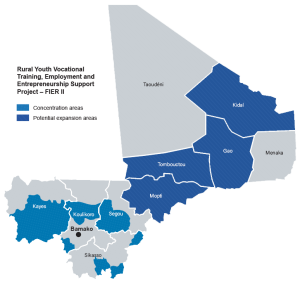 in the extension area will be based on a participatory identification of the priority circles of intervention in the four former regions with the regional councils and the actors of the agricultural and non-agricultural profession in relation to pre- and post-harvest activities.
The approach will be sequential with an initial level of targeting of aggregate infrastructure consisting of structural investments in production areas and a second level of targeting of young beneficiaries at the level of individual/private and collective initiatives, within the existing regional and core OPs which have planned/ongoing initiatives to consolidate/value/go to scale. Thus, the deployment of targeting will take place during the first two years in the FIER area (area of concentration) and will cover the same circles and villages. Then the study which will identify the production basins where the aggregate infrastructure will be installed will allow to retain the circles (maximum 12) and the villages to host these infrastructures, the principle being to ensure territorial fairness, while avoiding the sprinkler and dispersion of efforts.
Economic targeting:
IIt will be done through a prioritisation of economic activities, accessible to rural, profitable and attractive young people. An evaluation of the market and value chains will be carried out to understand segments with high potential for youth engagement and related market trends, and to identify innovative and promising business opportunities best suited to young people. Economic targeting will follow a thematic approach according to the chosen channels and value chains to be exploited. In this way, both in the area of concentration and in the area of extension, the following activities and sectors will be consolidated or developed:
- vegetable products including mariching and rice farming
- animal production with a focus on mouthpiece
- aquaculture
- Crafts, etc.
The FIER II interventions in these fields will allow the development and consolidation of activities for related trades.
Selection of infrastructure sites :
In the area of consolidation, villages are pre-identified by previous FIER I interventions, where youth awareness and recruitment mechanisms have already been established. The aim will be to target new young people with initiatives within the development (infrastructure) that will be built in the production areas. This may lead to work in new villages that were not taken into account in the first phase but whose choice will follow the relevant criteria that will be defined in relation to the potential for production and job creation for young people.
In the extension area, the targeting of villages will be both technical through the identification of production pools and the identification of potentially manageable sites. It will be social, taking into account the degree of poverty or vulnerability of each area, but also young people and youth networks active in the production process and in value chains.
The intervention strategy of FIER II
It is based on the following principles:
- Financial and non-financial support, complementary and articulated between them, is provided to young people as part of a personal professional microproject;
- The aim of the project is to facilitate the establishment of young beneficiaries in economically profitable trades and activities, which enable them to register their personal development for the long term;
- The project responds to a request for eligible support (selection of candidates according to profiles) and relevant (suitability of the personal microproject to the candidate's profile and the opportunities of the fields); The expression of these requests is prompted and accompanied by the project;
- The microprojects of young people are built with the applicants to ensure their personal commitment; In the same spirit, they will also be asked to contribute to the financing of the microproject (mostly in kind);
- FIER II builds on local opportunities at all levels of high-potential value chains and facilitates the economic integration of young people with support adapted to their age, level of education, previous work experience, personal circumstances and career choices;
- In a cross-cutting way, FIER II aims to strengthen the resilience of communities and agro-pastoral systems to climate change by promoting climate-smart farming practices (CSA) and green technologies;
- Differentiation of support by age group and by occupational project also makes it possible to adapt the project's responses to the real needs of rural youth, taking into account the diversity of personal situations, particularly those of young women;
- The project's support is based on the development of the existing capacities of local institutions, both in terms of training and integration and in support of rural entrepreneurship. At the same time, the project will invest in building and developing these capacities with a view to the sustainability of the integration scheme, with particular emphasis on OPs to play a greater role in supporting their members in training and advisory support.
- FIER II will promote collaborative entrepreneurship among young people, emphasizing the importance of collaboration and complementarity. Thus, the project will promote the combination of skills, know-how, and experiences of young people who wish to start entrepreneurial activity by clusters of villages, by sectors, by agricultural sectors, and especially by links of the same agricultural value chain. The aim is to achieve a common goal by adopting a collective responsibility. In order to optimize the way in which it operates, innovative institutional arrangements (co-operative enterprises piloting sub-projects of supply chains) will be promoted. In this context, local FIER success experiences will be capitalized. In addition, young local champions will be promoted to play the role of role models/mentors to inspire and strengthen the capacities of their young colleagues and for continuous learning and knowledge sharing.
- The intervention will take into account the context of fragility in Mali, including the considerations related to the security of goods and people, in the choice of intervention areas.