Who we are
 Home > About Proud
Second vocational training, integration and entrepreneurship support project for rural youth – FIER II
Contribute to wealth creation and poverty reduction for rural youth in Mali
FIER II RATTACHE TO THE MINISTER FOR NATIONAL ENTREPRENEURY, EMPLOYMENT AND VOCATIONAL TRAINING
FIER II is under the supervision of the Ministry of National Entrepreneurship, Employment and Vocational Training (MENEFP), which is responsible for the management of the project through a National Steering Committee, chaired by him. The department monitors the implementation of the project in accordance with the commitments of the Government, facilitates political and social dialogue and coordination with its other branches and structures and with all public, private and international actors.
The Project is an initiative of the Government of Mali and the International Fund for Agricultural Development (IFAD).
Background
In Mali, an additional 300,000 young people enter the labour market each year, mainly in rural areas, which are hampered by limited access to training, capital and inputs. In addition, these young people constitute bait for terrorist groups in the territory. Unfortunately, despite the efforts of the Government and its development partners, the country remains under-invested in job creation.
IFAD through FIER (completed in 2022) has shown that it can help meet this challenge. About 13 263 Rural youth technical training, including 12 505 were financed for income-generating activities and 758 for rural microenterprises. The project covered approximately 1 504 villagesaccompanied 9 decentralised financing structures (SFD) whose capacity of credit officers (73 in total) in services to rural youth has been strengthened.
In view of the performance achieved by FIER, the Government requested IFAD's intervention to implement a second project, with the ambition to capitalize on the lessons learned to move towards scaling up.
The Second Vocational Training, Integration and Support for Rural Youth Entrepreneurship Project - FIER II-
FIER II is therefore designed to consolidate and amplify the results of FIER, supporting the economic inclusion of rural youth in various value chains with high potential, by supporting their agro-sylvo-pastoral and fisheries (ASPH) economic activities along the agricultural and non-agricultural sectors. It also aims to improve the efficiency and effectiveness of implementation processes. The entrepreneurial potential of young women in particular, largely untapped in the agricultural and craft sectors, will be exploited, as will the strong commitment of local and regional authorities to improve the situation of young people in their territories, including by providing them with land resources.
The FIER II Mode of Action
Building on the lessons learned from FIER, FIER II promotes a market-oriented approach to vocational training and job creation, through improving the institutional capacities of actors at various levels in agricultural and non-agricultural value chains. This approach also promotes vocational and technical training for farmers, processors, traders and other actors, both upstream and downstream of production. The development of cooperative co-enterprises will be strengthened by the rigorous selection of high-potential value chains (especially those in which women play an important role and earn substantial income), taking into account opportunities in geographically located markets around production pools and clusters of rural microenterprises. This will provide technical and financial support to a larger number of young people in the project.
Objectives, duration and costs
The aim of FIER II is to help create wealth and reduce poverty for rural youth in Mali.
The development objective is to promote entrepreneurship in rural areas and to facilitate the economic integration of young people in agricultural value chains and non-agricultural subsectors.
In the long term, 60,000 rural young people aged 15 to 40 will benefit from vocational training and/or economic integration into a niche that is conducive to entrepreneurship or paid employment. Rural youth, 40% of whom will be women, will be integrated into supply chains that are permanently connected to input and product markets.
The project duration is seven (07) years. The total cost (unforeseen and all taxes included) is estimated at USD 100.0 million equivalent to CFAF 59.5 billion.
Governance and implementation arrangements
The project is under the supervision of the Ministry of National Entrepreneurship, Employment and Vocational Training (MENEFP), which is responsible for managing the project.
By administrative act, the Ministry of the Interior has established the arrangements for the pilotage and guidance of FIER II.
The National Steering Committee (NPC) is composed by representatives: Key Ministries (Finance ; Rural development; Entrepreneurship, Employment and Vocational Training; youth, etc.); specialized agencies for training and promotion of youth employment; the National Youth Council; the Consular Chambers (CCIM, APCMM, APCAM), the Patronate and the Regional Councils.
The mandate of the LWOP is to monitor the progress of the Project and to ensure that its objectives are met and that its response strategy is met. In each intervention region, a Regional Coordination Committee (CRC) is also established to, inter alia, approve the annual work programmes and budgets (PTBA) prepared by the Regional Project Coordination Unit in collaboration with the Technical Unit of the Regional Council.
A National Coordination Unit is set up, with managerial autonomy.
UCN is composed of:
- 1 national coordinator,
- 1 expert in promoting employment for rural youth,
- 1 professional training expert;
- 1 gender specialist;
- 1 rural engineering engineer;
- 1 specialist in rural finance;
- 1 Monitoring/Evaluation Officer assisted by
- 1 expert in knowledge management and communication;
- 1 administrative and financial officer;
- 1 procurement specialist;
- 1 Administrative Assistant;
- 1 accountant;
- 1 Executive Secretary
- Three drivers.
As required, the NCU regularly uses the services of nutrition and environmental management specialists.
In each intervention region, a Regional Coordination Unit is established within the Regional Council. Under the coordination of the NCU, RCUs have administrative and financial autonomy.
LURC consists of:
- 1 regional coordinator
- a professional training specialist;
- an economic integration specialist for rural youth, an evaluation monitoring assistant,
- an accounting assistant,
- 1 Administrative Assistant,
- Two drivers.
The team of technical advisers of the Regional Council participates, in collaboration with the UCR, in the elaboration of the PTBA in order to develop the relationship between this document and the annual plan of activities of the Regional Council which is attached to the regional economic development strategy.
Implementation partnerships
FIER II works according to the principle of doing. The UCN signs contracts with youth targeting and guidance operators (OCO). These are the study offices and NGOs selected on a competitive basis, but also the umbrella organisations of producers, young people and women, with which the UCN can sign strategic partnership contracts. To this end, with the support of the resource centres, the Project has set up a small pool of operators and relevant providers by region. This file has been established as part of a call for expressions of interest and is updated every two years. In the start-up regions, an indicative list of potential implementing partners shall be drawn up on the basis of the envisaged mandate and the capacity of those partners to fulfil the mandate. In addition, the NCU contracted an Aggregation Facilitation Operator (FAO) with international experience in this area to facilitate the integration of rural youth into market-connected supply chains. The construction of resilient aggregate infrastructure will be entrusted to selected companies also on a competitive basis. The project has developed a partnership with the technical services, for the preparation of technical dossiers and the monitoring of civil engineering works (dimensions, constructions, etc.), as well as for the implementation of vocational training schemes and the technical support of young beneficiaries.
The Principles of Intervention
FIER has shown its relevance in terms of positioning and approach strategy for rural youth. A goal of FIER II is to reach more young people by drawing all the useful lessons from FIER. The aim is to continue institutional support for the vocational training environment in Mali and to step up the implementation of the AGR/SME for young people, with a view to ensuring the sustainability actions through the installation and/or strengthening of local capacities (in particular at local, national and regional OP level), and to improve Efficiency through the review of processes and the aggregation of young people around collective projects. Building on the broad operational modalities of FIER.
Implementation of FIER II
It is planned in two phases. The first of two years, is a continuation of FIER and concerns areas of concentration in which the project supports the young people already beneficiaries of FIER for the development of their AGR/MER and the young people selected by FIER but who could not be financed due to lack of funds. During these two years, the project will prepare the second phase, which will take place over five years.
FIER II Intervention Areas
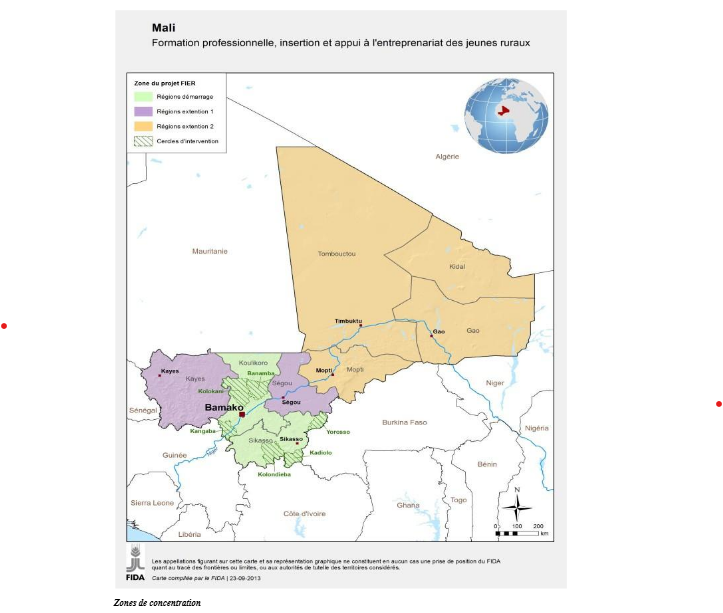
The project will potentially take place in all regions of Mali. However, in order to avoid dispersal, the project's intervention area will be reduced to the regions covered by the FIER project. This is the Zone 1 called concentration zone which includes the former regions of Koulikoro, Sikasso, Kayes and Ségou and the Zone 2 called Extension Zone the regions of Mopti, Gao, Timbuktu and Kidal. This choice takes into account the current constraints of fragility and safety and the approach based on consolidation of production pool/value chain/ERM. Project intervention will be gradual, starting with the concentration area to gradually expand to the new area, using qualitative indicators (triggers) « ) linked to aggregate production and processing infrastructures.
FIER II Components
The project's activities are structured around the following three components:
- Component A: Making the institutional and socio-economic environment conducive to promoting entrepreneurship and employment for rural youth
- Component B: Support rural youth to generate decent income through sustainable access to financial and non-financial services tailored to their needs and market requirements
- Component C: Coordination and management.