Financing
 Home > Financing
THE FIER II FUNDING MECHANISM
Promoting access of rural youth (F&H) to appropriate financial services
FIER II aims to promote sustainable access to financial services for rural youth Respondent the needs of their economic activities in the agricultural and non-agricultural sectors in rural areas. Its implementation will produce the following expected results:
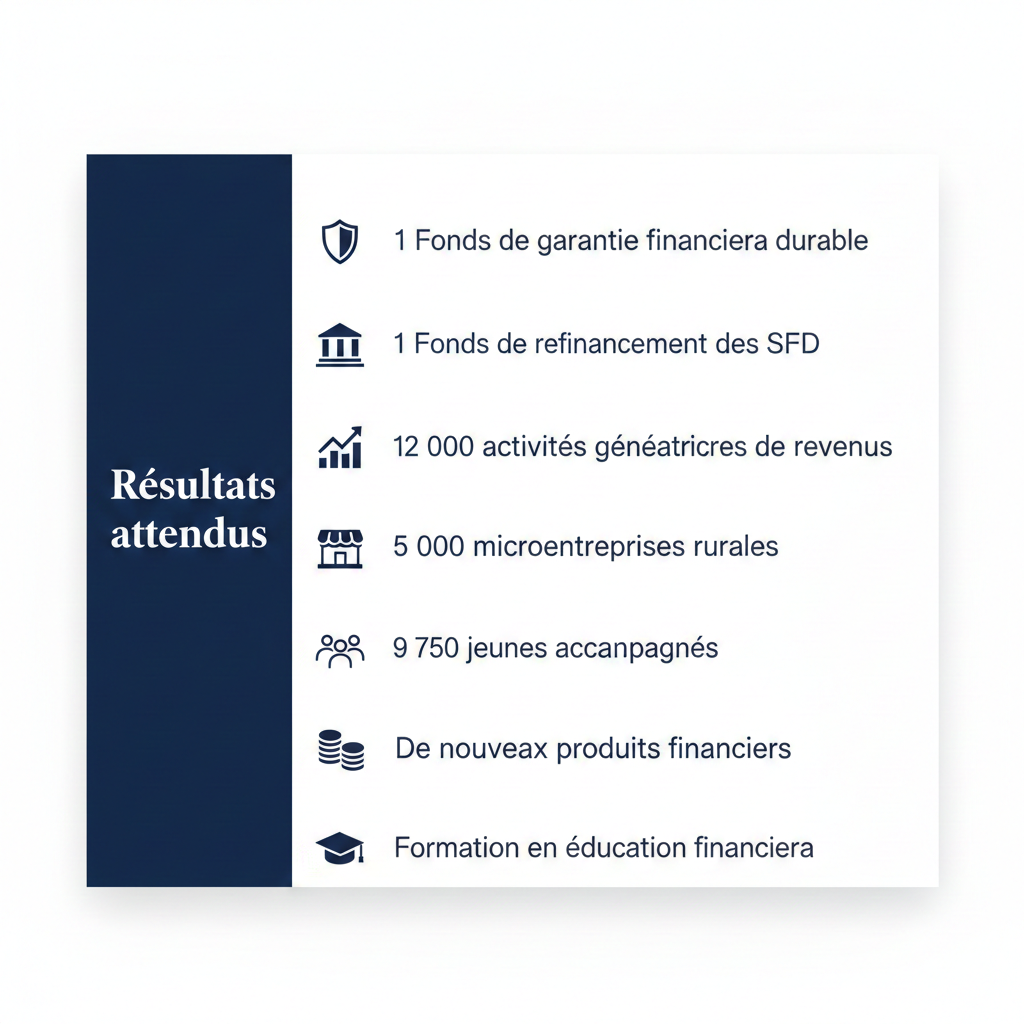
These results will be achieved through the implementation of two main activities, including:
- the establishment of sustainable risk-sharing and funding mechanisms for rural youth;
the promotion access of rural youth to financial services.
Establishing sustainable risk-sharing and funding mechanisms for rural youth
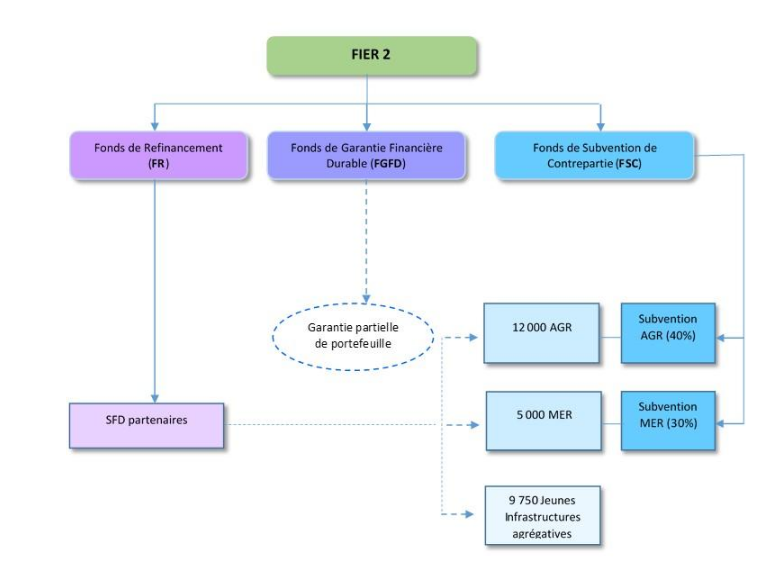
FIER II helps to facilitate access to financial services for rural young people engaged in activities in a manner Individual or collective on the different links in the agricultural value chain or in rural non-agricultural activities. To this end, the project will adopt a new approach with a shared-cost financing architecture involving a tripartite contribution, i.e. the youth contribution, the direct grant provided by FIER II and the credit granted by a rural financing institution and guaranteed by a financial guarantee fund. Three complementary instruments are therefore in place:
- a Sustainable Financial Guarantee Fund (SGF);
- a Refinancing Fund (FR) of Decentralised Financial Services (DFS) project partners;
- a Counterpart Grant Fund (CSF).
The Sustainable Financial Guarantee Fund (GFFD) :
The objective of this fund is to mitigate the credit risks taken by the rural financing institutions partners in financing youth projects. The FGFD offers partial risk coverage of youth funding for agricultural and non-agricultural activities in rural areas. Partial coverage avoids the complete transfer of the full risk of credit the guarantee fund, which could result in a non-restrictive assessment of credit applications by partner rural financing institutions and a laxity in the management and monitoring of appropriations.
For income-generating activities (AGR) promoters, the coverage rate is 80% for the first credit cycle and 50% for subsequent credits. For promoters of rural micro-enterprises (MERs), the fund provides a partial guarantee up to 50% of the amount of the credit granted, as promoters already benefit from some experience in the conduct of their activities. The FGFD thus offers the SFD partners a portfolio guarantee for all credits granted by SFD to beneficiaries of FIER II. The management costs of the FGFD are borne by the project and by the interest generated by the financial allocation for the risk cover that is placed within a bank. The FGFD has the advantage of creating a multiplier effect by allowing young people access to several credit cycles. A young person has the possibility to use several cycles of credits covered by the FGFD as long as he/she reimburses the credits previously obtained. This is why young people are made aware of the need to repay the loans contracted from the SFD partners in order to be able to benefit from subsequent credits. The SFDs, on their part, are invited to ensure effective monitoring of the credits granted.
The SFD Refinancing Fund (FR).
The objective of the refinancing fund is to provide SFDs with the liquidity needed to grant loans to rural youth. A manual for the management of the refinancing fund under FIER II is also being prepared. To benefit from this refinancing line, the SFD has signed an agreement with the project. It is expected that the FR will contribute to the refinancing of around 40% of the amount of credits granted by the SFD to young beneficiaries of FIER II. This fund is revolving in so far as the refinancing granted to SFDs is recycled once repaid.
The Counterpart Grant Fund (CSF).
This fund helps to provide grants for the implementation of youth projects. The grant facilitates the settlement of rural youth, who are mostly without capital either for the launch of their activities (AGR) or for the development or extension of existing activities (MER). It will be granted to young people engaged in agricultural or non-agricultural activities in rural areas. It thus helps to reduce the funding constraints faced by young people by reducing their contribution to the financing of their projects, and the cost of financing their projects, as it reduces the proportion of credit in the financing of projects.
The priority of the grant is to reduce the costs of investment in equipment or development for the start-up or extension of youth activities. It may also be used to finance part of the working capital in the event of any remaining balance after full coverage of equipment or development requirements. The release of the grant for the youth project requires an agreement in principle from the SFD for the provision of supplementary financing in the form of credit. This agreement-in-principle must be given by the SFD at the time of the evaluation of the youth project, with the SFD being part of the project evaluation process. This agreement in principle is followed by the opening of the young person's account with the SFD, through which the young person's cash contribution is paid and the grant.
Disbursements must be validated in advance by those responsible for monitoring the activities of young people and released on presentation of a pro-forma invoice or an estimated estimate. The DFS credit can be implemented at the same time as the grant or at a later time depending on the project's funding needs. The grant is awarded to young people in the form of an insertion kit for AGR promoters and a development kit for MER promoters.
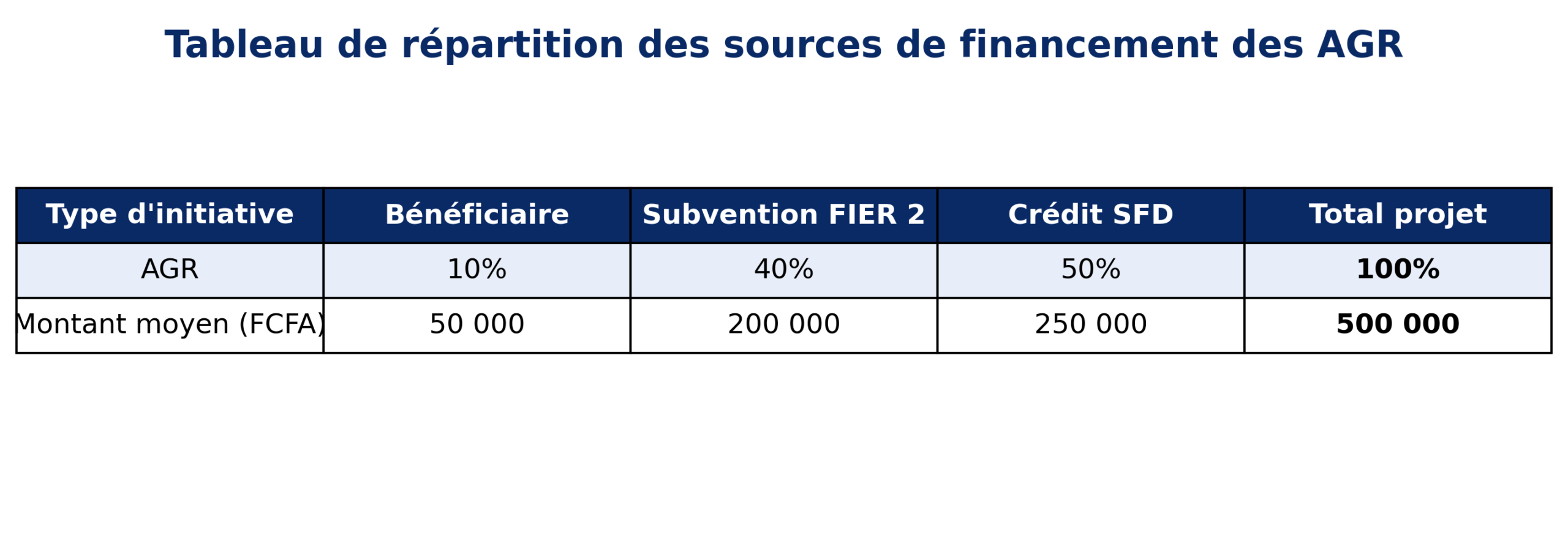
Insertion kit. The integration kit serves as initial capital that allows young people to start their project as part of an agricultural or non-agricultural activity in rural areas. It is paid after the young person has released his personal contribution in cash or in kind. In the case of in-kind contributions, an assessment of the value the contribution is made by the project or by the provider in charge of monitoring the project of the young person. The insertion kit allows the young person to acquire the necessary equipment to start his activity or to make the necessary arrangements. The provider in charge of monitoring the young person's project must ensure the quality of the equipment acquired or the arrangements made. The grant thus enables the acquisition of various types of equipment, including agricultural equipment, livestock equipment, broodstock, processing equipment, land-use equipment, equipment needed to launch a non-agricultural rural activity, etc. Where all equipment requirements are met, the remainder of the grant may be used to finance part of the working capital. The sources of funding for the youth project are then distributed as follows:
- Youth contribution in cash or in kind (10%);
- 40% direct subsidy (integration kit);
- a loan contracted with an SFD (50%) and receiving partial coverage from the Durable Financial Guarantee Fund.
The average cost of starting an income-generating activity is estimated at CFAF 500,000.This corresponds to an average amount of the insertion kit estimated at CFAF 200,000. The maximum amount to be paid as an insertion kit is CFAF 300,000. A total of 12,000 rural youth (AGR) are expected to benefit from the integration kit.
Development kit. This kit is intended for promoters of the SEA in the agricultural and non-agricultural sectors in rural areas. The kit provides the necessary equipment to increase production, processing or supply of products and services in rural areas. The equipment needs of the young person, necessary for the extension or consolidation of his activities, must be detailed in his business plan, which must also indicate the different sources of funding for the implementation of his project. The development kit will be paid after the young person has released his personal cash contribution.
In the case of MERs, only cash contributions will be accepted. The provider responsible for monitoring the young person's project shall also ensure the quality of the equipment acquired or the arrangements made for the extension of activities. Given that SEA proponents already have experience in carrying out their activities, they may already have accounts in a financial institution. In this case, the institution will have to give its agreement in principle for the financing of the extension project and the grant will be paid into the young person's account to this institution financial resources. Otherwise, the project will facilitate its interaction with a partner SFD. The sources of funding for an SEA proponent's project are as follows:
- Youth contribution in cash or in kind (10%);
- 30% direct subsidy (development kit);
- credit contracted to an SFD (60%) and partially covered by the Durable Financial Guarantee Fund.
According to estimates made, the average cost of implementing a MER project is CFAF 3 million.which corresponds to an average amount of the development kit estimated 900,000 CFA francs. The maximum amount to be paid as a development kit is CFAF 1.5 million. A total of 5,000 rural youth are expected to benefit from the development kit.
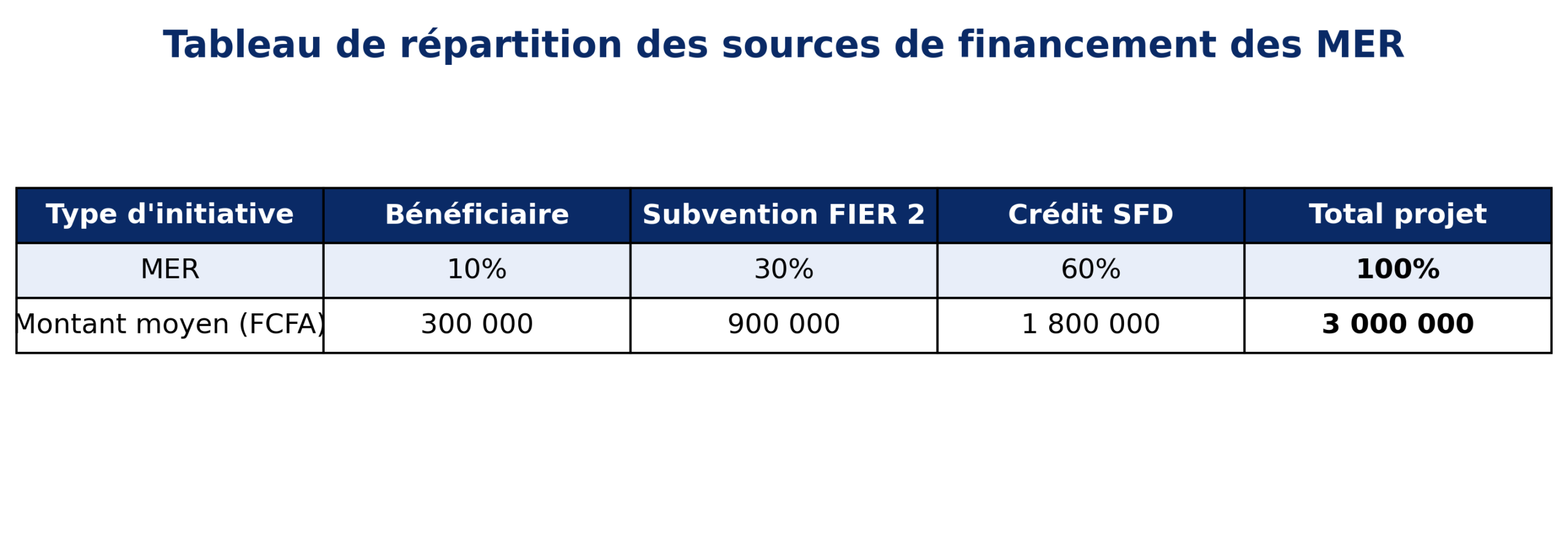
Figure 1: FIER 2 financial instruments
Arrangements for making grants available.
The implementation of the grants requires a partnership with the SFDs which must give their agreement in principle for the additional funding necessary to carry out the youth project. This agreement in principle is a sine qua non for the direct grant to the young person. To this end, the SFDs are represented on the regional project selection committees and participate in the evaluation of projects in order to ensure that accepted projects are bankable.
In order to benefit from the direct grant, the young person must first submit a pro-forma invoice or estimate which is validated by the person responsible for monitoring his activities. Equipment should preferably be purchased from suppliers of equipment approved by the project to ensure its quality. Payment can then be made directly in the supplier account. However, if necessary, the funds may be disbursed by the young person after validation of the disbursement by the person responsible for monitoring the activities of the young person.
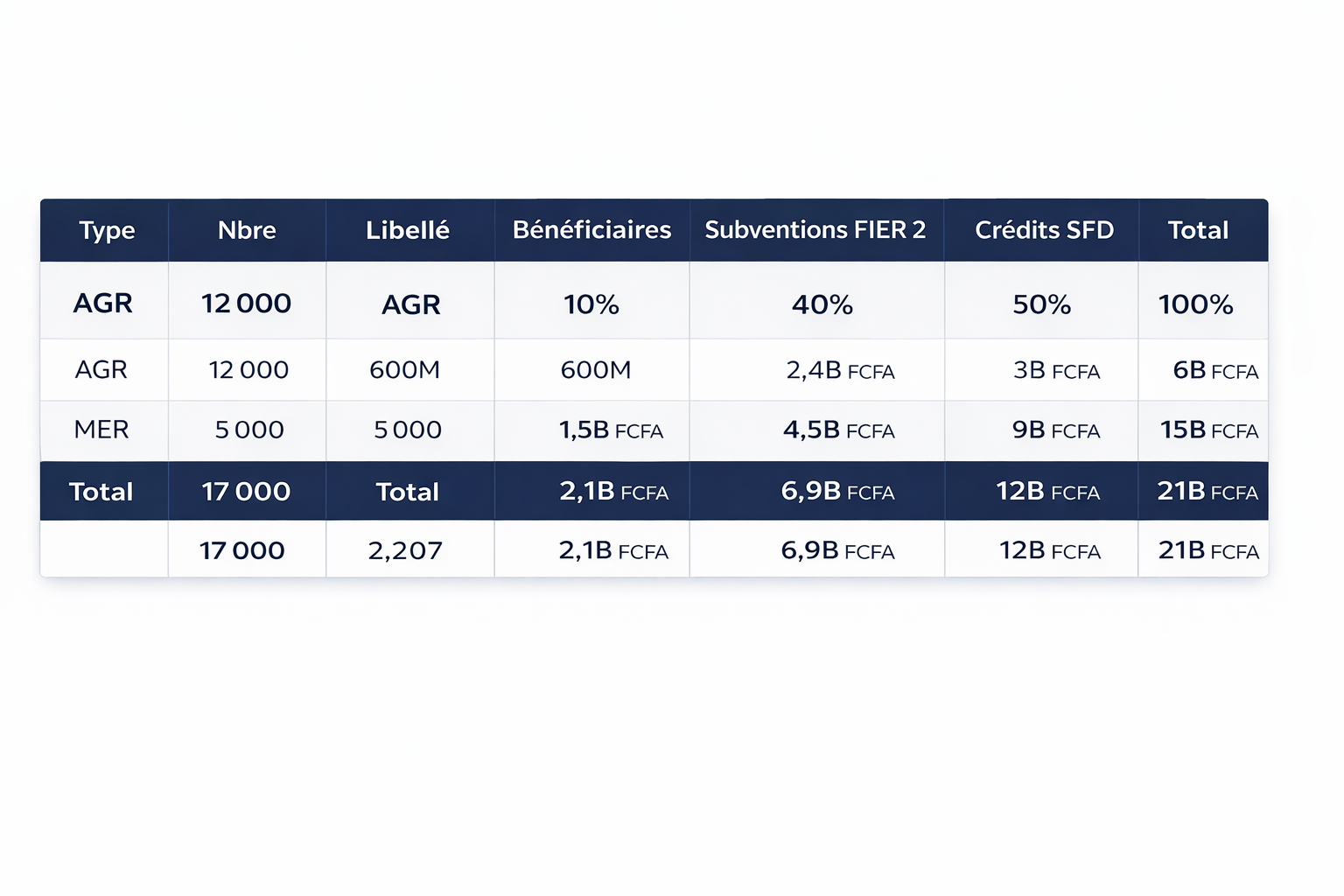
(i) The credit amounts are determined here on the basis of a credit cycle per young person. They therefore do not take account of the renewal of credits by young people.
Promoting rural youth access to financial services
FIER II supports the promotion of access for rural youth to financial services tailored to their needs. The proposed support is focused on the following four areas:
- support for the development of new financial products;
- Building the capacity of young people in financial education and supporting savings;
- the promotion of group credits;
- capacity building of partner SFDs.
Support for the development of new products.
Since FIER II is a little more part of a value chain approach and in the financing of rural young people working in agricultural and non-agricultural occupations, two studies have been carried out by the project:
- A study on the supply and demand of financial products and services offered throughout the agricultural value chain to see if current products and services can meet the financing needs of young people who will be integrated into the various links in the value chain. The results of the study identified constraints/inadequacies and made recommendations on new products addressed to young people in the various segments of the agricultural value chain.
- A study on the supply and demand of non-agricultural financial products and services in order to obtain an idea of the financial products and services currently offered by FDS in non-agricultural sectors in rural areas. On the basis of the findings, the recommended study of new financial products adapted to the needs of young people which FIER II wishes to include in non-agricultural sectors.
Training in financial education and support for savings.
Inadequacies in financial education have been noted among the young beneficiaries of FIER by the SFDs and by the accompanying NGOs. This resulted in a large number of beneficiaries who were unaware of the financial services and products offered by FDS and who did not sufficiently develop savings habits. In order to remedy these shortcomings, FIER II supports the capacity-building of beneficiaries in financial education. This training will help them develop their business relationship with FDS, build them on the savings culture and better manage the financial resources available to them. It will also help them manage the revenue and expenditure associated with their activities and improve credit management. The training modules in financial education have been adapted to the profile of the beneficiaries (level of literacy, economic activities, etc.) and the logistical means available.
Promotion of group credits.
During the first period of FIER II, young people will be able to access financial services through individual microprojects. However, in order to improve efficiency, the cluster approach will be gradually introduced during the second implementation period. This approach will be driven by the dynamics of supply chain sub-projects driven by aggregators, including cooperative joint ventures (CECs). To this end, the project will Support the establishment of aggregative infrastructure in the form of a grant to finance the investments necessary for the construction of such infrastructure. Activities will be organized so that young people can carry out their activities in groups (marriage perimeters, embossed perimeters, rice perimeters, aquaculture perimeters, artisanal centres, etc.). Each perimeter will house a number of young people according to the activities carried out. The need for working capital for each group of young people to carry out the activities will be financed by the contribution of young people (10%) and by group credit to a partner SFD (90%). These needs will be aggregated at the level of the CEC, which will support requests for funding from youth groups to the SFD through purchase contracts signed by the CEC with youth groups and sales contracts signed by the CEC with collectors, processors and other market operators. The approval of these credits will be the sole responsibility of each partner SFD. These contracts have the advantage of reassuring SFDs of the existence of a market for the disposal of young people's products. The financial guarantee fund will provide partial coverage of these credits up to 20% in addition to the solidarity guarantee provided by the group of young people. For the financing of the purchase of the production of youth groups, CECs will be able to submit credit applications to banks or SFDs with a high capacity for financing. These appropriations will also benefit from:
Table of estimated contributions expected from FIER II to finance the need for working capital (aggregative infrastructure)
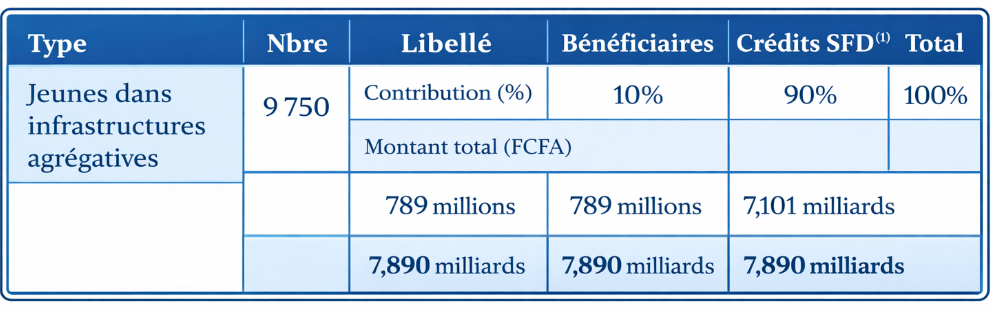
The credit amounts are determined here on the basis of a credit cycle per young person. They therefore do not take account of the renewal of credits by young people.
Capacity-building of DFS and extension support.
Under the first project (FIER) and through the partnership with the INCLUSIVE project, FIER contributed to the capacity building of FDS in agricultural financing. For example, IFDS partners from INCLUSIF, which were also partners of FIER, benefited from capacity building in agricultural financing. However, these SFDs will need to benefit from capacity building for the development of new financial products (warranting, micro-leasing, green financial products, etc.). To this end, FIER II works in collaboration with INCLUSIVE under its component A. In return, the FSDs are asked to speed up the processing of funding applications and to offer young people better credit conditions (duration, interest rates, moratorium, periodicity of repayment, etc.).
With regard to support for the extension of the SFD network, it should be noted that FIER has contributed to the establishment of 13 SFD windows out of the 17 planned in the project areas, which has helped to reduce the distance between the partner SFD windows and the locations of youth activities. Under the second project, support may be provided to SFDs according to the needs expressed. Such support may be of various kinds, including the contribution to the purchase of equipment and logistics for the newly created FDS windows, the contribution to the training of FDS staff, etc. FIER II will thus support the implementation of the 4 SFD windows which could not be set up during FIER in order to pursue the objective of community financing for the benefit of the project's targets.